Books by Dave Whitaker

Check out Toolbox Training books and more at WritbyWhit.com or David L. Whitaker's author page at Amazon.com.

Showing posts with label 100 Game Activities for Kids. Show all posts

Thursday, February 16, 2017

February 16: World Championship Crab Races

image from pinterest.com


Crabs and Crawdads

Materials:

  • none

Directions:

  1. Playing field must be divided into two equal halves.
  2. Players group in two equal teams, one on each side of center line.
  3. One side is the crabs team and the other the crawdads.
  4. Caller yells out either “crabs” or “crawdads.”
  5. If caller yells “crabs” then the crabs must run from center line back to their base without being tagged by the crawdads. If caller yells “crawdads” then the crabs chase the crawdads.
  6. Any player tagged joins the other side.
  7. Game ends when all players are on one side.

Variations:

  • Caller should stretch out word as much as possible and occasionally bluff by yelling other words starting with ‘cr’ (crackers, crumb, etc.)
  • This game can be done along with ‘Rock, Paper, Scissors’. Team decides on one of the three and then everyone regroups at center line. At count of three, everyone offers up the appropriate sign for their team and winning side chases other side.
  • Create 3 or 4 teams.

Source(s): 100 Game Activities for Kids (activity A5)


Check out the full February calendar. It includes floating holidays, specialty weeks, and specialty months.

Thursday, February 9, 2017

February 9: Volleyball invented (1895)

image from ihmmumbaisports.blogspot.com


Circle Volleyball

Materials:

  • balloon

Directions:

  1. Kids sit in a circle and take turns batting a balloon to keep it up in the air.
  2. Let the group keep track of how many times they hit it in the air before it touches the ground.
  3. You might also see how many kids can hit the balloon before it touches the ground.

Variations:

  • Add more balloons.
  • Scoot chairs out farther.

Source(s): 100 Game Activities for Kids (activity C15)


Check out the full February calendar. It includes floating holidays, specialty weeks, and specialty months.

Tuesday, February 7, 2017

February 7: Run for Your Life Day

image from flickr.com

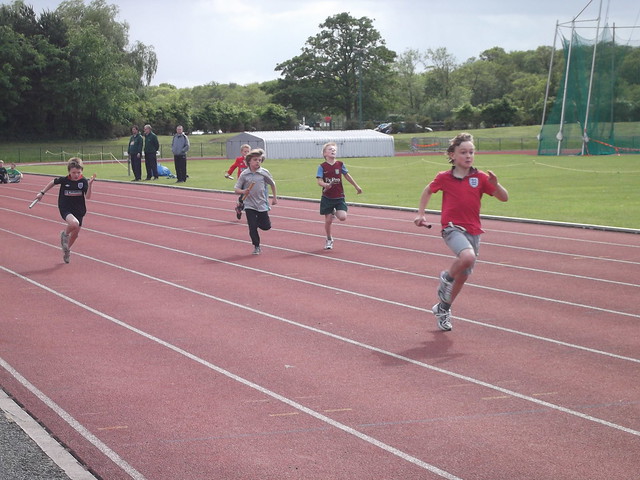
A section in the Toolbox Training book 100 Game Activities for Kids focuses on relays. Below are the directions for more traditional relays.


Tradtional Relays

Materials:

  • depends on relay

Directions:

  1. Divide kids into at least two teams with four to eight kids per team ideally.
  2. Determine if children go only once or more than once.
  3. You may wish to have a stopwatch on hand.
  4. Pick an action (hop, run, skip, run backwards, crab walk, jump, crawl, etc.).
  5. Each child must get to designated area and back doing that action.

Variations:

  • Vary how many teams there are.
  • Vary how many players are on each team.
  • Change the distance children have to run or skip, etc.
  • Have each child in the relay perform a different action. Example: the first one has to hop, the second one has to run backwards, etc.
  • With small groups (4 or under), you could have each child go multiple times and they have to perform a different action each time.

Source(s): 100 Game Activities for Kids (activity D1)


Check out the full February calendar. It includes floating holidays, specialty weeks, and specialty months.
Thursday, February 25, 2016

February 25: Don't Utter a Word Day (Quiet Day)

image from reviewtrackers.com


Mum Ball

Materials:

  • a ball

Directions:

  1. This is a great game for transition times, quiet times, or circle time.
  2. Players sit in a circle.
  3. Players roll a ball back and forth without making any noise.
  4. If someone makes noise, (s)he is out.
  5. Play continues until only one player remains.

Variations:

  • For variety, kids who are out can walk around the back of the circle and try to get other players to make noise (no contact or noise allowed from those children who are out).
  • Also consider requiring the ball to remain in the circle or roller or receiver is out (your choice).
  • For a more active game, players can stand and ball can be thrown.

Source(s): 100 Game Activities for Kids (activity G1)


Check out the full February calendar. It includes floating holidays, specialty weeks, and specialty months.

Tuesday, February 23, 2016

February 23: Tennis Day

image from batestennis.com


Group Tennis

Materials:

  • One coat hanger per player
  • One leg of panty hose per player
  • One tennis ball for every four kids
  • Chalk or other means for marking boundaries

Directions:

  1. Have each child use his coat hanger and panty hose to make a tennis racket. This will take some extra preparation time outside of the actual game.
  2. Kids divide into two teams, one for each side of a designated “court” area.
  3. The court should be no larger than an actual tennis court, preferably much smaller. Courts must have marked boundaries and a center line.
  4. Regular rules of tennis apply - only one bounce per side, but this game allows for teams larger than doubles.
  5. Have teams play to a set number of points (ten is good) and then mix up the players.

Variations:

  • Use a playground ball and no rackets.
  • If you have several games going, vary the size of the court for each.
  • Change the number of points needed to win each round.
  • If you have four or more teams, set up a mini-tournament.
  • Vary the number of team players per round.

Source(s): 100 Game Activities for Kids (activity C13)


Check out the full February calendar. It includes floating holidays, specialty weeks, and specialty months.

Saturday, February 20, 2016

February 20: John Glenn Becomes First Man to Orbit Moon (1962)

image from Wikipedia.org

To celebrate the day, kids can play this space-themed game:


Satellite

Materials:

  • A chair

Directions:

  1. The astronaut begins in the middle of the play area touching a chair (a spaceship).
  2. The astronaut can leave the spaceship for only ten seconds at a time before he/she must go back for air.
  3. During the ten seconds, the astronaut tries to capture as many satellites (other players) as possible.
  4. Any satellite tagged by the astronaut goes to the chair and becomes another astronaut.
  5. If an astronaut fails to make it back to the ship in ten seconds, then one satellite must be given up.
  6. Play continues untl only one satellite remains. This person becomes the new astronaut.
Source(s): Toolbox Training’s book 100 Game Activities for Kids (activity A14)


Check out the full February calendar. It includes floating holidays, specialty weeks, and specialty months.

Tuesday, May 19, 2015

May 19: Ringling brothers founded their circus (1884).

image from JoyBaker.com


The Circus Game

Materials:

  • Hula hoops

Directions:

  1. One person is picked as the lion tamer.
  2. This person has a hula hoop.
  3. Another person is picked to be a clown.
  4. The clown tries to tag the players (lions).
  5. Tagged lions must sit down.
  6. The lion tamer can bring the hula hoop to the lions. Once a lion passes through the hoop, it can return to play.
Source(s): 100 Game Activities for Kids (activity A7)


Check out the full May calendar. It includes floating holidays, specialty weeks, and specialty months.

Thursday, October 9, 2014

October 9: First two-way telephone conversation (1876)

image from misterjogja.com

Aside from the interesting discussions which could be launched about how much the telephone has changed throughout its history, there is also a fun, simple, circle-time game kids can play called “Telephone”:


Telephone

Materials:

  • none

Directions:

  1. A one-sentence message is initiated by the adult or a child if an adult approves the message first.
  2. Kids form a line or sit in a circle.
  3. The message is whispered to the first child.
  4. That child may not have the message repeated.
  5. (S)he then repeats the message as close to the original as possible to the next child in line.
  6. The message continues through the “telephone chain” until every child hears it.
  7. The last child then states what message (s)he heard to see how closely it matches the original message.
Source: Toolbox Training’s book 100 Game Activities for Kids (activity G4).

Also check out the construction card set (activity I4).


Check out the full October calendar. It includes floating holidays, specialty weeks, and specialty months.

Saturday, October 4, 2014

October 4: First space vehicle launched (1957).

image from blogs.ubc.ca

In celebration of the first space vehicle ever launched, kids can make their own rockets.


Rockets

Materials:

  • toilet paper rolls
  • small sheets of paper-sized cardboard
  • acrylic paints

Directions:

  1. This activity is directed toward individual table-top projects, but if you have large boxes available, let the kids create a life-sized rocket.
  2. Let kids use materials as they wish to design their rockets.
  3. To get kids thinking, ask questions like: What is the name of this rocket? Where are you going to go in this rocket? How long will it take? Are there people on this flight? If so, how many? How much food will you need? Where do you eat? Where do you sleep? How do you control the rocket ship? When is it set to launch? Has it already launched? Can you bring pets? Does it have rocket boosters? What country is it from?
Source(s): Toolbox Training’s construction card set. Also consider activities A14 and G5 from Toolbox Training’s book 100 Game Activities for Kids.


Check out the full October calendar. It includes floating holidays, specialty weeks, and specialty months.

Tuesday, May 31, 2005

Workshop: Creating Games with Kids

Check out the workshops tab for a full list of titles as well as prices and other information. All Toolbox Training workshops are also available as do-it-yourself training packages. Click that tab for more details.


What you’ll get from this workshop or training package:

  • Know the 3 ways children benefit from making up games
  • Recognize the 4 ways adults benefit
  • Master the basics of brainstorming with kids
  • Understand the 4 approaches to recreating games
  • Learn how to create new games entirely from scratch
  • Implement the “tape recorder” method for testing and touching up new games
  • Practice skills with sample games actually created by children

For this training package, Toolbox Training highly recommends the book Games, Games, Games: Creating Hundreds of Group Games and Sports. Click on the book cover for details.

.

To have this delivered as an on-site workshop contact Toolbox Training.


To order as a do-it-yourself training package (catalog # MGTP0505):

You can also download an order form here.


Training packages come with workbooks, certificates, and evaluations for 10 participants, but you can also order additional workbooks, etc. (catalog # MGTW0505) if necessary:


For more Toolbox Training workshops and training packages, check here.

Sunday, March 31, 2002

Workshop: Make Every Game a Success

Check out the workshops tab for a full list of titles as well as prices and other information. All Toolbox Training workshops are also available as do-it-yourself training packages. Click that tab for more details.


What you’ll get from this workshop or training package:

  • Recognize the 5 characteristics of every game
  • Understand that games come in a wide variety
  • Master the 3 stages of successful games
  • Establish a G.A.M.E. Plan to use with any game
  • Know when to lay low and when to leap in
  • Learn how to step in, step up, and step out
  • Identify the roles of children and adults
  • Put your new skills to work with a trial run

For this training package, Toolbox Training highly recommends the book Games, Games, Games: Creating Hundreds of Group Games and Sports. Click on the book cover for details.

.

To have this delivered as an on-site workshop contact Toolbox Training.


To order as a do-it-yourself training package (catalog # GMTP0302):

You can also download an order form here.


Training packages come with workbooks, certificates, and evaluations for 10 participants, but you can also order additional workbooks, etc. (catalog # GMTW0302) if necessary:


For more Toolbox Training workshops and training packages, check here.